Phase-specific dynamics
Separate solid and gas predictors learn distinct motion patterns, instead of requiring one undifferentiated dynamics model to explain both.
PHYSICS-GROUNDED VIDEO GENERATION · 2026
Different phases follow different motion laws.
We learn their dynamics and interactions as 3D trajectories to guide video generation.
1 Nanjing University2 Shenzhen University of Advanced Technology3 SenseTime4 Shenzhen Technology University
* Corresponding author
HOW IT WORKS
PAVG follows the learned-trajectory route to video generation: physics conditions determine motion in an explicit 3D representation, and a video model supplies the visual appearance. The key design is to preserve phase-specific dynamics while learning their interaction.
Lift the initial scene into phase-labeled 3D points.
Solid and gas branches, connected by solid-to-gas attention.
Project the predicted point motion into image space.
Condition the video generator on the projected motion.
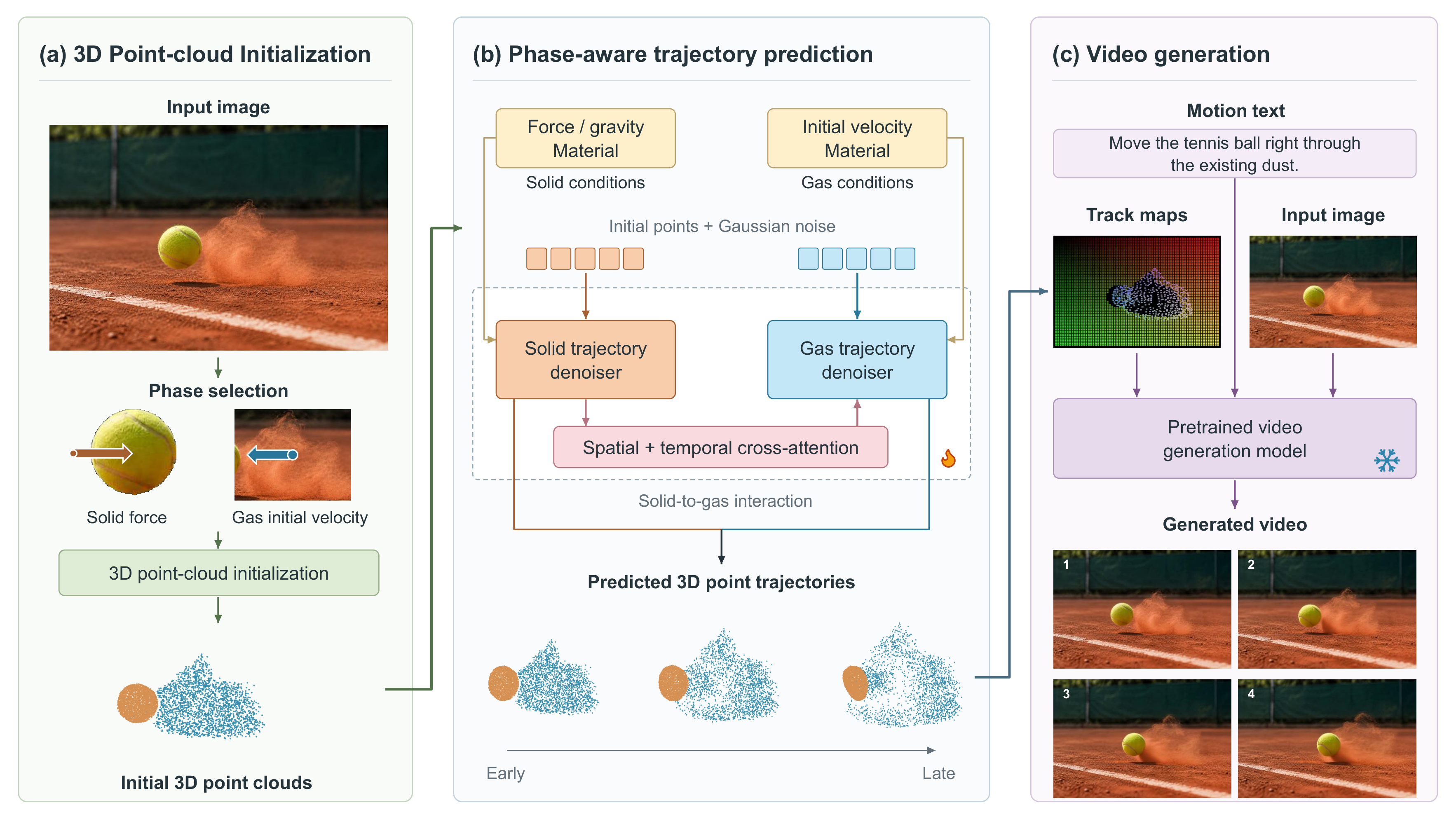
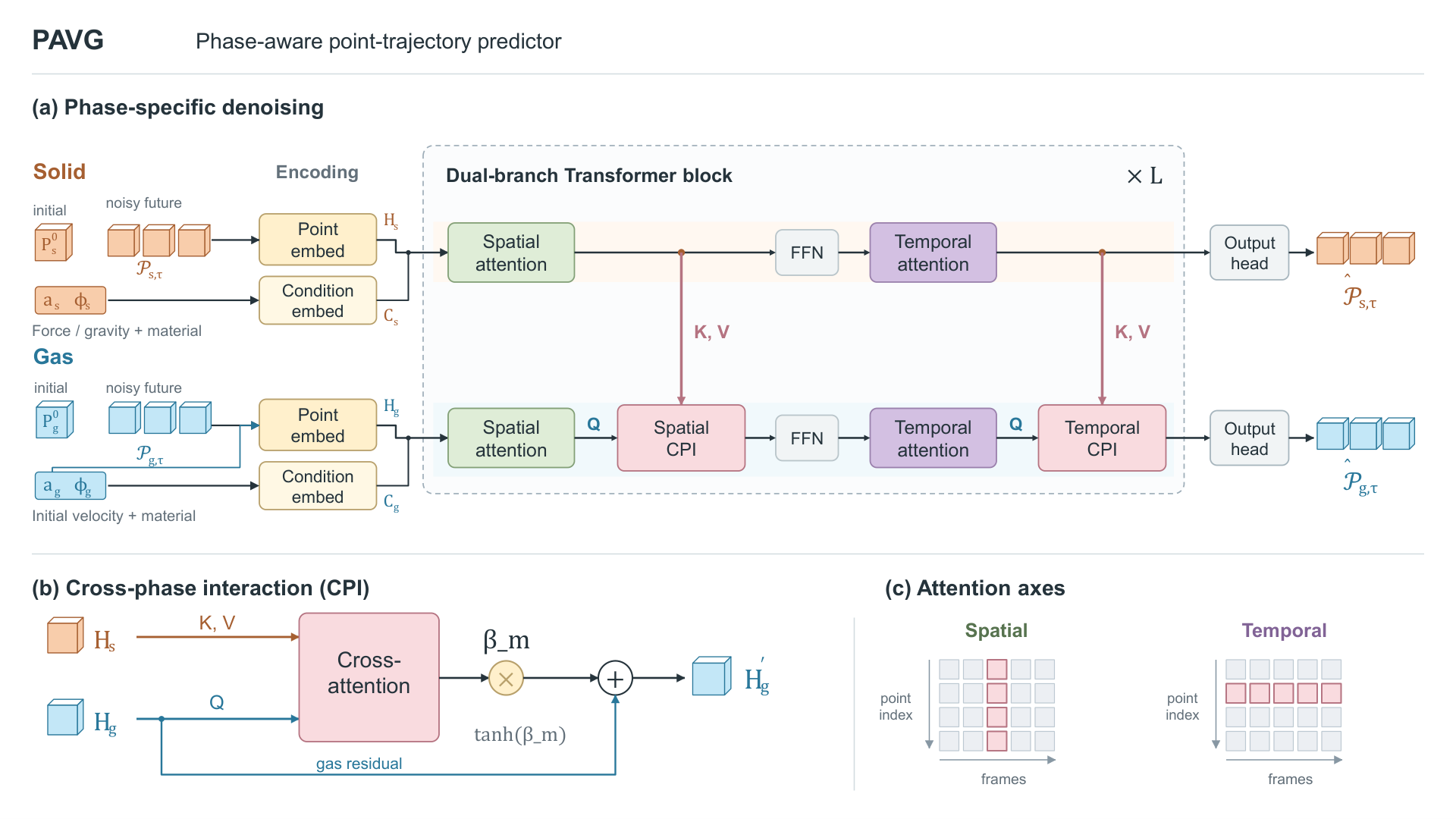
Phase-specific pretraining is followed by coupled training. The learned representation keeps fixed point identities across future frames. In the present model, cross-phase influence runs from solid to gas.
THE IDEA
Solids may retain structure, deform, or respond to contact. Gases evolve through transport, pressure, dissipation, and buoyancy. A useful physical motion model must preserve these differences while capturing how one phase influences another.
Separate solid and gas predictors learn distinct motion patterns, instead of requiring one undifferentiated dynamics model to explain both.
Spatiotemporal cross-attention conveys solid motion to the gas branch, modeling where, when, and how the surrounding gas responds.
Both branches predict 3D point trajectories. Their projections provide motion guidance to a video generator while retaining an explicit physical intermediate representation.
Our experiments study solid dynamics, gas dynamics, and solid-to-gas interactions. Here, “phase” means a modeled state of matter; it does not mean a phase transition.
SEE THE MOTION
Selected examples with their physical inputs and predicted motion.
Solid–gas interaction
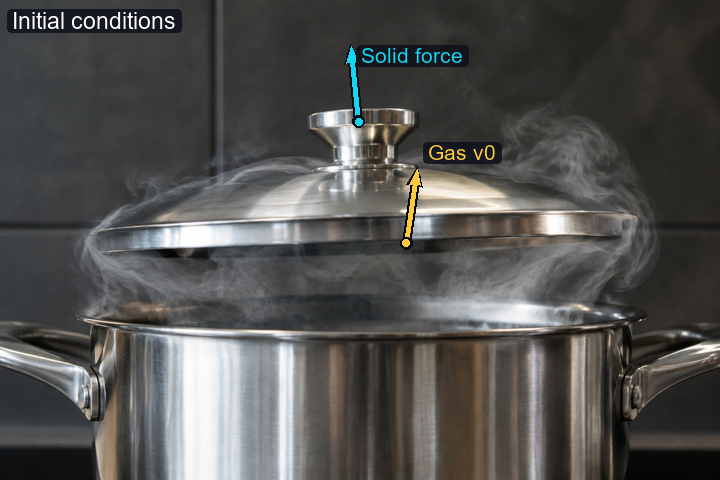
Cyan: solid force / points. Gold: gas initial velocity / points. Arrow tails mark the solid force point or the gas centroid. Arrow lengths illustrate direction.
Solid–gas interaction
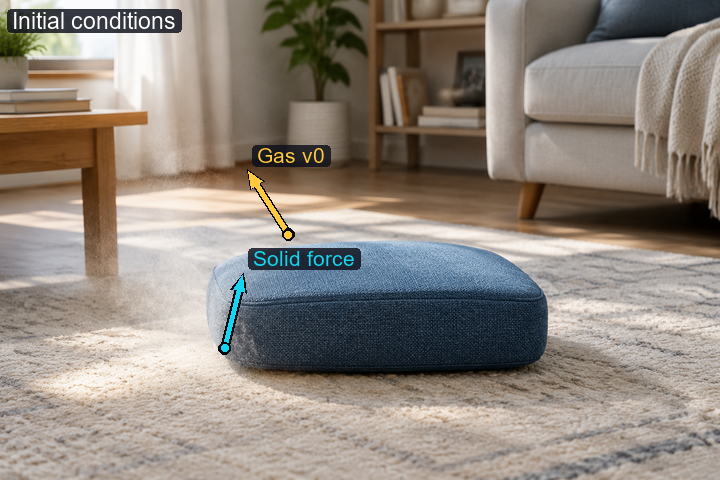
Cyan: solid force / points. Gold: gas initial velocity / points. Arrow tails mark the solid force point or the gas centroid. Arrow lengths illustrate direction.
Solid–gas interaction
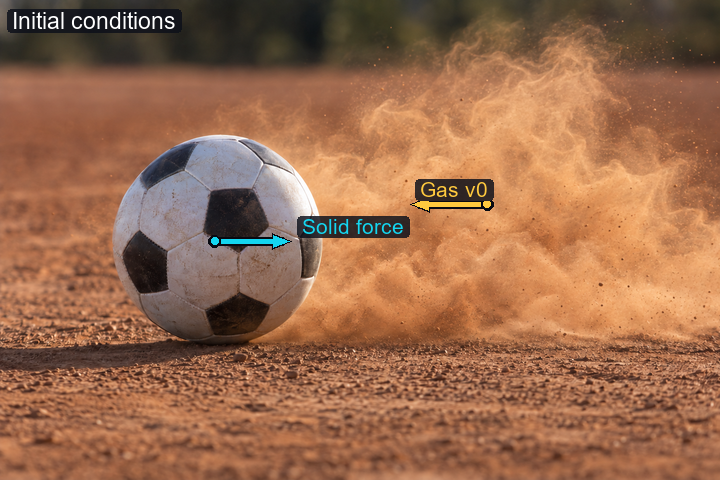
Cyan: solid force / points. Gold: gas initial velocity / points. Arrow tails mark the solid force point or the gas centroid. Arrow lengths illustrate direction.
Solid–gas interaction
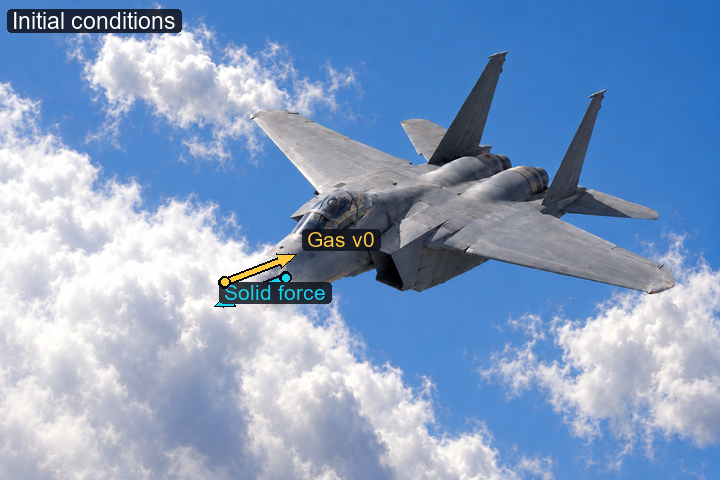
Cyan: solid force / points. Gold: gas initial velocity / points. Arrow tails mark the solid force point or the gas centroid. Arrow lengths illustrate direction.
Gas dynamics
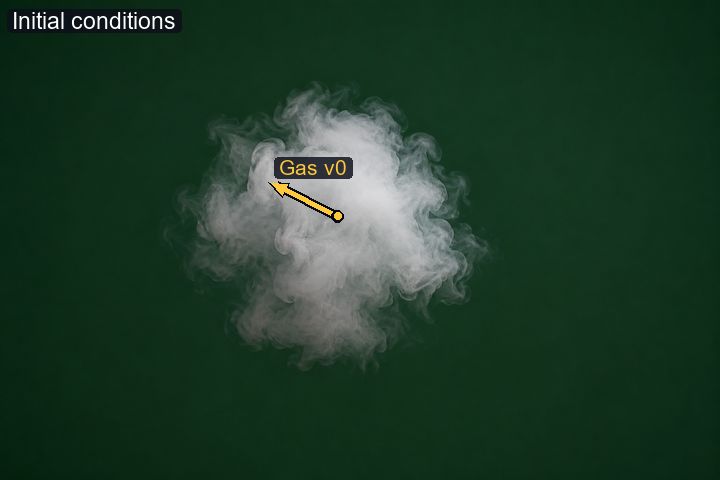
Cyan: solid force / points. Gold: gas initial velocity / points. Arrow tails mark the solid force point or the gas centroid. Arrow lengths illustrate direction.
Gas dynamics
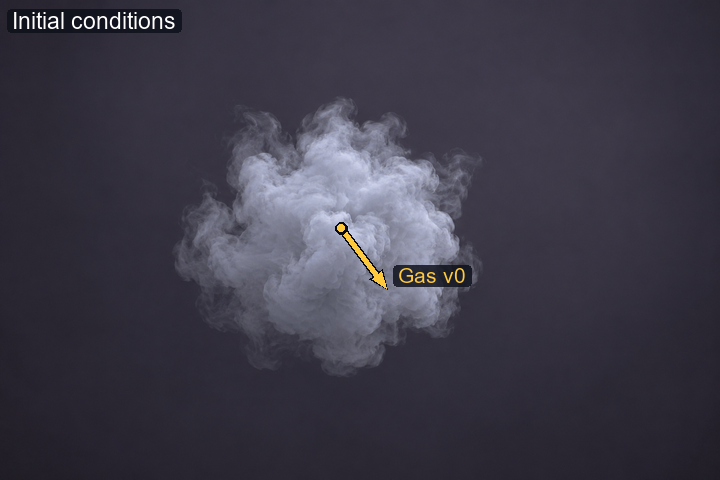
Cyan: solid force / points. Gold: gas initial velocity / points. Arrow tails mark the solid force point or the gas centroid. Arrow lengths illustrate direction.
Gas dynamics
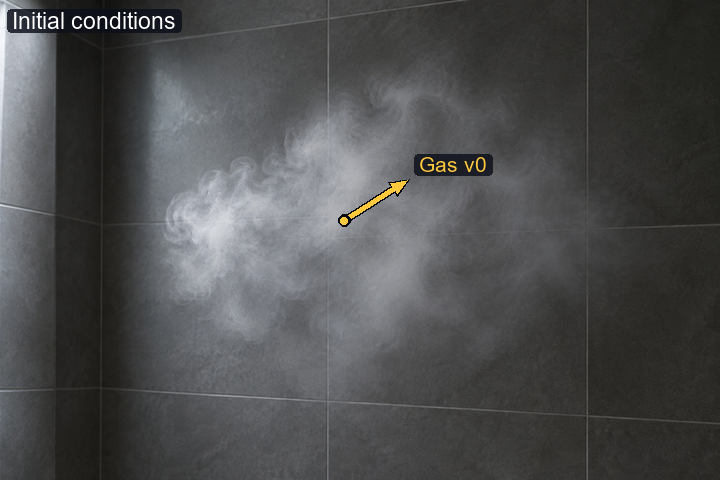
Cyan: solid force / points. Gold: gas initial velocity / points. Arrow tails mark the solid force point or the gas centroid. Arrow lengths illustrate direction.
Gas dynamics
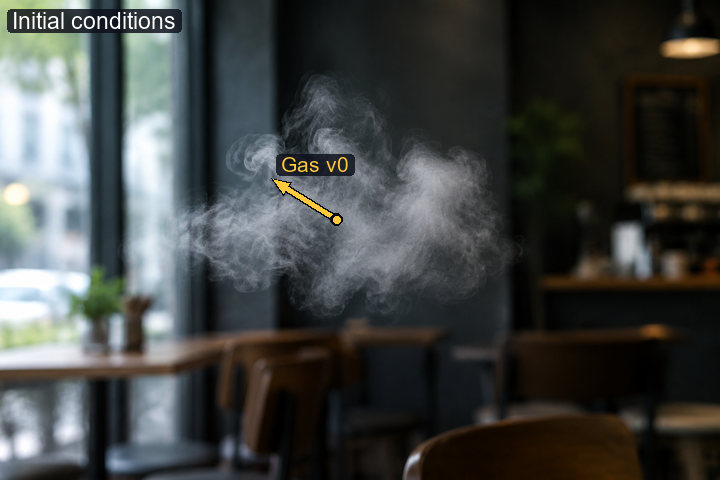
Cyan: solid force / points. Gold: gas initial velocity / points. Arrow tails mark the solid force point or the gas centroid. Arrow lengths illustrate direction.
Solid dynamics
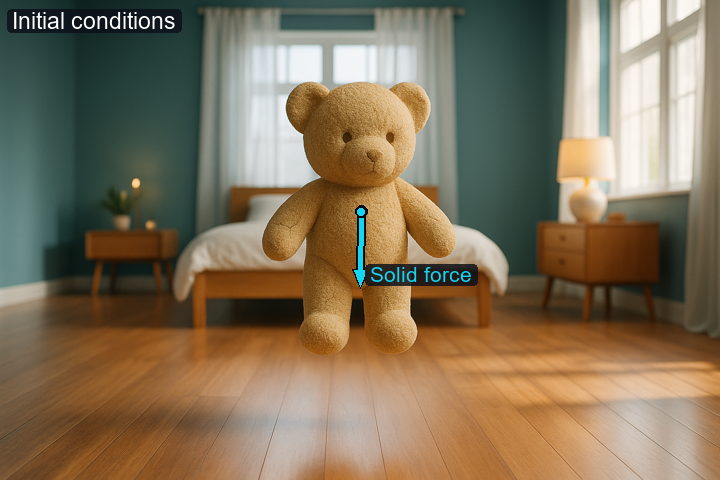
Cyan: solid force / points. Gold: gas initial velocity / points. Arrow tails mark the solid force point or the gas centroid. Arrow lengths illustrate direction.
Solid dynamics
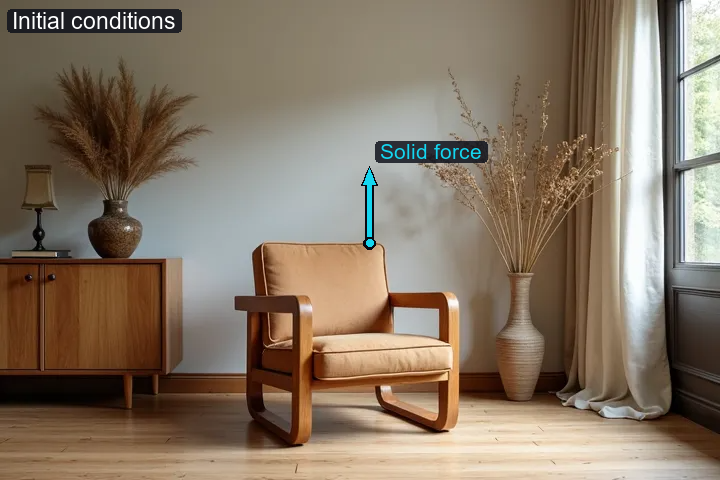
Cyan: solid force / points. Gold: gas initial velocity / points. Arrow tails mark the solid force point or the gas centroid. Arrow lengths illustrate direction.
Solid dynamics
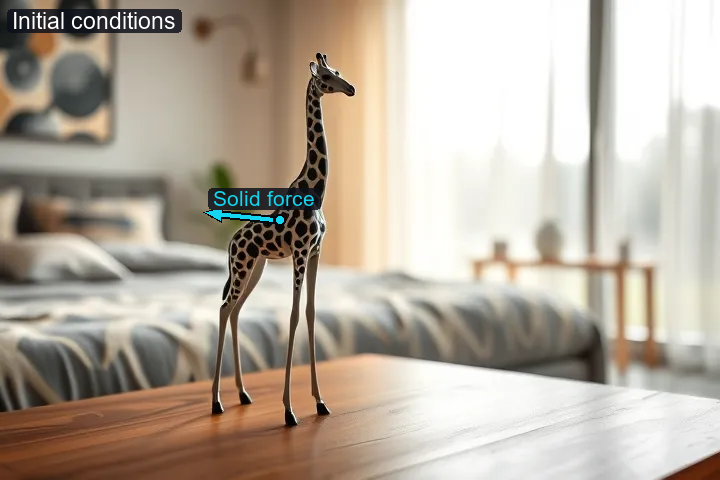
Cyan: solid force / points. Gold: gas initial velocity / points. Arrow tails mark the solid force point or the gas centroid. Arrow lengths illustrate direction.
Solid dynamics
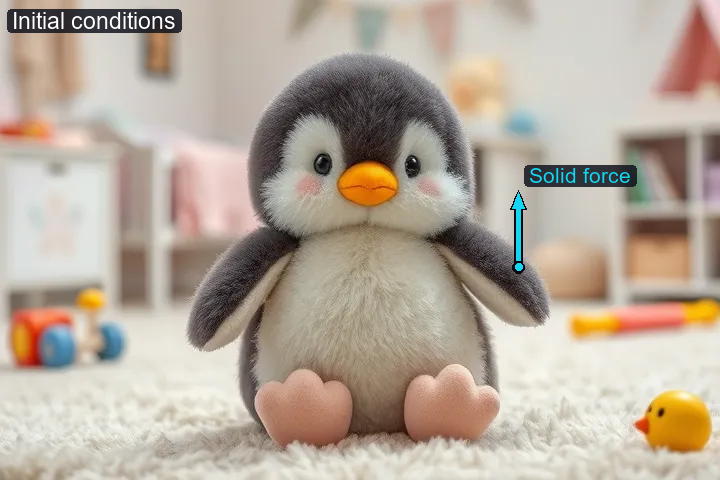
Cyan: solid force / points. Gold: gas initial velocity / points. Arrow tails mark the solid force point or the gas centroid. Arrow lengths illustrate direction.
Explore 12 examples, from initial conditions to predicted 3D trajectories to generated video. The initial image marks solid force and uniform gas initial velocity. Both videos play together. Example details.
DATA & EVALUATION
Initial 3D states, physical conditions and future point trajectories cover solid motion, gas transport and their interaction.
Solid points are orange. Gas points are blue.
Dot: force position. Arrow: force direction.
|f| = 3.03 per particle in simulation units.
Elastic materials, plasticine, sand and rigid bodies under force or gravity. Here, a local force acts on 131 selected points and gravity is disabled.
f = (1.451, −1.008, 2.462) per selected particle. Initial application center: (5.280, 4.315, 4.331). The dot follows that material point. The red patch marks the selected region. Arrow length is illustrative.
Arrow: initial flow at the cloud center.
|v₀| = 2.16 in simulation velocity units.
Gas evolution with initial-velocity conditions, generated using MantaFlow. Fixed point identities retain the motion of individual markers over time. The arrow shows the cloud-wide initial velocity condition, with the centroid used as a visual reference.
Blue: gas force. Purple: ball force.
Gas: 10 pN right · Ball: 7 pN left
The gas cloud and ball start apart and move toward each other. Gas paths bend around the moving ball.
Both forces remain constant over 0–4.8 s. Gas force: (10, 0, 0) pN in a fixed spherical region centered at (−0.40, 0, 0) mm with radius 0.08 mm. Solid force: (−7, 0, 0) pN at the moving ball’s center. The ball starts at the origin with radius 0.10 mm. All 2048 gas markers start in one 3D ellipsoid centered at (−0.35, 0, 0) mm, with radii (0.13, 0.165, 0.165) mm. The initial gas-to-surface gap is at least 0.126 mm. No additional gas markers start near the ball. The ball’s velocity follows force balance in the carrier gas flow. Moving no-slip conditions change gas trajectories around the ball. This is quasi-steady creeping flow with negligible inertia, and the displayed gas points mark a parcel within a continuous carrier. The camera remains fixed, the solid uses only points, and the two arrows retain the initial external-force directions and application positions. Arrow lengths are illustrative. The 49 saved states loop over 6.125 s of playback. This supplementary simulation is separate from the frozen dataset and reported evaluations.
The solid–gas video is an additional low-Re Stokes-flow illustration, outside the frozen dataset and reported evaluations. Trajectory tests use fixed point identities and common normalization. The 32 video-generation scenes form a separate evaluation setting.
RESULTS THAT CAN BE MEASURED
Complete trajectory, video-generation and ablation results from the paper.
All ten predictors and all applicable settings. vIoU measures occupied-volume overlap; CD measures Chamfer distance; Corr measures correspondence-aware pointwise L2 error. Higher vIoU and lower CD and Corr are better.
| Method | Overall | Single-phase solid | Single-phase gas | Solid–gas interaction | ||||||||
|---|---|---|---|---|---|---|---|---|---|---|---|---|
| vIoU ↑ | CD ↓ | Corr ↓ | vIoU ↑ | CD ↓ | Corr ↓ | vIoU ↑ | CD ↓ | Corr ↓ | vIoU ↑ | CD ↓ | Corr ↓ | |
| SFBC | — | — | — | — | — | — | 0.483874 | 0.120906 | 0.274170 | — | — | — |
| DLF | — | — | — | — | — | — | 0.483505 | 0.053650 | 0.241004 | — | — | — |
| SEGNN | — | — | — | — | — | — | 0.561893 | 0.007060 | 0.176081 | — | — | — |
| Motion2VecSets | — | — | — | 0.141172 | 0.842913 | 0.656012 | — | — | — | — | — | — |
| MDM | — | — | — | 0.357344 | 0.097770 | 0.246086 | — | — | — | — | — | — |
| PhysCtrl | — | — | — | 0.588372 | 0.022882 | 0.080403 | — | — | — | — | — | — |
| GNS | 0.465241 | 0.027480 | 0.209879 | 0.422463 | 0.039714 | 0.163346 | 0.559694 | 0.007163 | 0.176219 | 0.439404 | 0.031521 | 0.249974 |
| HGATSolver | 0.449227 | 0.068079 | 0.223303 | 0.306664 | 0.163993 | 0.309513 | 0.570428 | 0.006277 | 0.116932 | 0.459907 | 0.051023 | 0.233384 |
| Fisale | 0.518143 | 0.036205 | 0.182453 | 0.478780 | 0.054490 | 0.144728 | 0.578805 | 0.005874 | 0.117675 | 0.507492 | 0.042229 | 0.233703 |
| PAVG | 0.696343 | 0.006630 | 0.062433 | 0.611964 | 0.017294 | 0.068361 | 0.793352 | 0.001370 | 0.061515 | 0.690028 | 0.003928 | 0.059928 |
Overall = 25% solid + 25% gas + 50% interaction. Interaction metrics use concatenated solid and gas point sets. — means the method does not apply to that setting. Values retain the paper’s six decimal places. Bold marks the best reported result.
Five multimodal judges score semantic adherence (SA), physical commonsense (PC) and video quality (VQ). Scores average equally over 32 scenes and five judges.
| Method | SA ↑ | PC ↑ | VQ ↑ |
|---|---|---|---|
| HunyuanVideo-1.5 | 3.11 | 3.03 | 3.66 |
| Wan2.2-I2V-A14B | 3.05 | 3.08 | 3.53 |
| CogVideoX1.5-5B-I2V | 2.26 | 2.46 | 2.93 |
| DragAnything | 2.40 | 2.45 | 2.69 |
| ObjCtrl-2.5D | 2.28 | 2.27 | 2.83 |
| FlashMotion | 3.17 | 3.18 | 3.58 |
| Wan-Move | 2.09 | 1.99 | 2.25 |
| Force Prompting | 2.03 | 2.24 | 2.86 |
| StreamForce | 1.91 | 2.04 | 2.78 |
| PhysCtrl | 3.10 | 2.98 | 3.33 |
| PAVG | 3.39 | 3.28 | 3.61 |
Bold marks the best result; underlining marks the second best.
Each judge evaluates the same eleven methods on the same 32 scenes using the shared rubric.
| Method | GPT-4o | GPT-5.5 | GPT-5.6-sol | Gemini-3.8-flash | DeepSeek-v4.1-flash | ||||||||||
|---|---|---|---|---|---|---|---|---|---|---|---|---|---|---|---|
| SA ↑ | PC ↑ | VQ ↑ | SA ↑ | PC ↑ | VQ ↑ | SA ↑ | PC ↑ | VQ ↑ | SA ↑ | PC ↑ | VQ ↑ | SA ↑ | PC ↑ | VQ ↑ | |
| HunyuanVideo-1.5 | 3.63 | 3.63 | 3.88 | 3.06 | 2.91 | 3.59 | 2.94 | 2.75 | 3.69 | 3.00 | 3.00 | 3.63 | 2.94 | 2.88 | 3.53 |
| Wan2.2-I2V-A14B | 3.31 | 3.50 | 3.81 | 3.16 | 3.19 | 3.44 | 2.53 | 2.41 | 3.34 | 2.94 | 3.00 | 3.53 | 3.31 | 3.28 | 3.53 |
| CogVideoX1.5-5B-I2V | 2.75 | 2.94 | 3.41 | 2.13 | 2.31 | 2.72 | 1.84 | 2.19 | 2.75 | 2.31 | 2.47 | 2.91 | 2.25 | 2.41 | 2.84 |
| DragAnything | 2.78 | 2.81 | 3.06 | 2.38 | 2.31 | 2.50 | 1.94 | 2.09 | 2.41 | 2.34 | 2.44 | 2.72 | 2.56 | 2.59 | 2.78 |
| ObjCtrl-2.5D | 2.59 | 2.66 | 3.03 | 2.09 | 2.03 | 2.75 | 2.16 | 2.06 | 2.75 | 2.50 | 2.53 | 2.88 | 2.03 | 2.06 | 2.72 |
| FlashMotion | 3.28 | 3.44 | 3.75 | 3.53 | 3.41 | 3.72 | 3.00 | 2.88 | 3.59 | 2.94 | 3.03 | 3.47 | 3.09 | 3.13 | 3.38 |
| Wan-Move | 2.47 | 2.47 | 3.00 | 2.03 | 1.84 | 1.81 | 1.75 | 1.63 | 1.78 | 2.34 | 2.34 | 2.50 | 1.88 | 1.69 | 2.16 |
| Force Prompting | 2.28 | 2.41 | 2.88 | 2.09 | 2.25 | 3.00 | 1.69 | 2.03 | 2.72 | 2.13 | 2.34 | 3.03 | 1.97 | 2.16 | 2.69 |
| StreamForce | 2.34 | 2.41 | 2.97 | 1.75 | 1.81 | 2.75 | 1.44 | 1.72 | 2.50 | 2.00 | 2.19 | 2.94 | 2.03 | 2.09 | 2.72 |
| PhysCtrl | 3.41 | 3.47 | 3.78 | 2.88 | 2.81 | 3.13 | 3.22 | 2.84 | 3.34 | 3.19 | 3.13 | 3.31 | 2.81 | 2.63 | 3.09 |
| PAVG | 3.75 | 3.78 | 4.00 | 3.41 | 3.25 | 3.66 | 3.44 | 3.19 | 3.53 | 3.34 | 3.22 | 3.53 | 3.00 | 2.94 | 3.31 |
Participants select the best videos for physical plausibility and overall video quality. A selection rate counts every tied choice, so rates across methods may sum to more than 100%.
| Method | Physical plausibility | Overall video quality |
|---|---|---|
| HunyuanVideo-1.5 | 23.12% | 21.67% |
| Wan2.2-I2V-A14B | 18.12% | 21.04% |
| CogVideoX1.5-5B-I2V | 3.54% | 5.00% |
| DragAnything | 5.62% | 3.96% |
| ObjCtrl-2.5D | 3.96% | 4.17% |
| FlashMotion | 13.75% | 12.50% |
| Wan-Move | 5.42% | 3.54% |
| Force Prompting | 0.42% | 0.83% |
| StreamForce | 2.92% | 2.71% |
| PhysCtrl | 15.00% | 14.17% |
| PAVG | 32.50% | 32.08% |
Video scores and human preferences describe the paper’s fixed evaluation release. They were not recomputed for the selected demonstrations above.
Separate solid and gas predictors are compared with a unified predictor at matched cumulative training exposure per phase.
| Predictor | vIoU ↑ | CD ↓ | Corr ↓ |
|---|---|---|---|
| Solid-only | 0.588372 | 0.022882 | 0.080403 |
| Gas-only | N/A | N/A | N/A |
| Unified | 0.571150 | 0.024851 | 0.086428 |
| Predictor | vIoU ↑ | CD ↓ | Corr ↓ |
|---|---|---|---|
| Solid-only | N/A | N/A | N/A |
| Gas-only | 0.799263 | 0.001281 | 0.059713 |
| Unified | 0.722483 | 0.001984 | 0.083933 |
The same PAVG checkpoint is evaluated with solid-to-gas cross-attention enabled or disabled. Solid predictions remain identical.
| Variant | Joint solid–gas | Interaction: solid | Interaction: gas | ||||||
|---|---|---|---|---|---|---|---|---|---|
| vIoU ↑ | CD ↓ | Corr ↓ | vIoU ↑ | CD ↓ | Corr ↓ | vIoU ↑ | CD ↓ | Corr ↓ | |
| PAVG | 0.690028 | 0.003928 | 0.059928 | 0.728056 | 0.011593 | 0.049734 | 0.642296 | 0.003537 | 0.070121 |
| w/o solid-to-gas Cross-Attention | 0.540755 | 0.016072 | 0.178830 | 0.728056 | 0.011593 | 0.049734 | 0.428435 | 0.067136 | 0.307926 |
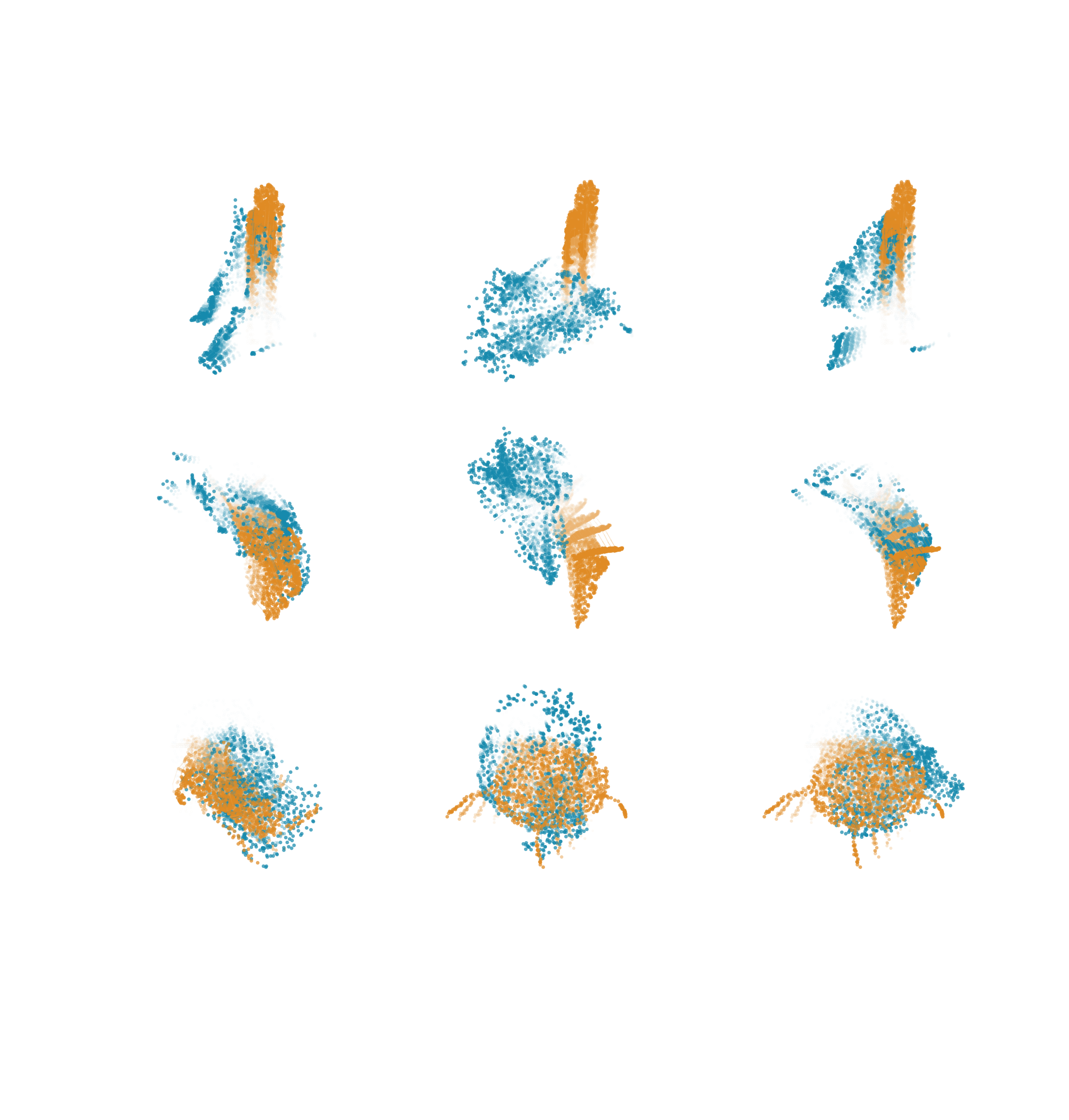
The same dual-branch architecture and reduced-loss training recipe use either random or phase-specific initialization. This controlled ablation has a different loss recipe from the main model.
| Initialization | Overall | Single-phase solid | Single-phase gas | Solid–gas interaction | ||||||||
|---|---|---|---|---|---|---|---|---|---|---|---|---|
| vIoU ↑ | CD ↓ | Corr ↓ | vIoU ↑ | CD ↓ | Corr ↓ | vIoU ↑ | CD ↓ | Corr ↓ | vIoU ↑ | CD ↓ | Corr ↓ | |
| Random | 0.644972 | 0.008163 | 0.082704 | 0.582268 | 0.022199 | 0.080927 | 0.710286 | 0.002036 | 0.096300 | 0.643667 | 0.004209 | 0.076795 |
| Phase-specific | 0.690964 | 0.006586 | 0.063135 | 0.617950 | 0.016784 | 0.067902 | 0.783433 | 0.001444 | 0.062611 | 0.681236 | 0.004059 | 0.061014 |
The coupling objective is enabled or removed under the matched reduced-loss recipe.
| Objective | vIoU ↑ | CD ↓ | Corr ↓ |
|---|---|---|---|
| Without coupling loss | 0.677608 | 0.003948 | 0.061509 |
| With coupling loss | 0.681236 | 0.004059 | 0.061014 |
Source: PAVG paper and experiment appendix. Structured quantitative tables.
CURRENT SCOPE
The current video pipeline initializes a 2.5D scene proxy from an image. Our experiments validate solids, gases, and one-way solid-to-gas influence; they do not establish full bidirectional coupling or general multiphase physics.
Liquids, phase transitions, stronger scene reconstruction, long-horizon prediction, and tighter preservation of trajectories in the generated pixels remain future directions.
Perceptual plausibility, human preferences, and numerical trajectory agreement provide complementary evidence. None alone certifies physical correctness in a real scene.
EXPLORE & BUILD
Read the paper, explore the code, and download pretrained models.
Full method, experiments, and appendix.
arXiv:2610.11791Trajectory settings, video evaluation, metrics, and baseline details.
Available in the paperInstallation, example inputs, video generation, training and evaluation.
View on GitHub ↗Pretrained joint trajectory predictor, solid and gas specialists, and matching configs.
Download on Hugging Face ↗PAVG source code and trajectory checkpoints are released under Apache-2.0. Third-party components retain their respective terms.
@misc{ou2026pavg,
  title={Phase-aware video generation for physics-grounded dynamics and interactions},
  author={Jingfeng Ou and Kun Wang and Rui Zhao and Jingwei Guan and
          Limin Wang and Chao Dong and Xingyu Zeng},
  year={2026},
  eprint={2610.11791},
  archivePrefix={arXiv},
  primaryClass={cs.CV},
  url={https://arxiv.org/abs/2610.11791}
}